Sparks, Stitches and Second Lives: Inside the UK's Repair Bench Studios
There is a smell to a good repair café, and it is not the one you would expect. Not solder or sawdust, though both are present. It is coffee, and the faint chemical ghost of contact cleaner, and the particular warm-dust smell of a forty-year-old sewing machine being coaxed back into life by someone who has owned one exactly like it since 1983.
On a Saturday morning in a church hall in south Wales, or a library meeting room in Leeds, or a converted railway arch in Manchester, a queue is forming. It is a queue of broken things. A lamp that flickers. A wool coat with a hole in the elbow. A radio that hums. A child's wooden toy with a snapped axle, carried by a child who is watching very closely indeed.
A broken toaster is a creative brief
What happens next is the bit that outsiders miss. Repair is not administration. It is design work under pressure, with the clock running and an audience of one.
A mender has to read an object they have never seen before, work out how it was assembled, guess which of six possible faults is the live one, and then find a way to make it work again with the tools on the table and the parts in the tin. That is a creative brief with a hard deadline. It is also, quietly, the most disciplined training in materials and construction that many makers ever get.
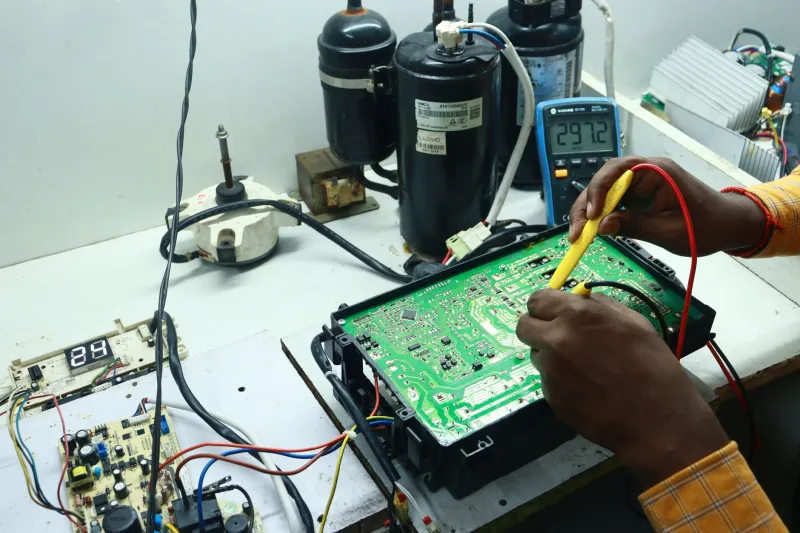
Textile menders know this in their bones. A visible mend on a 1970s knit is a design decision, not a patch. Woodworkers rebuilding a chair joint are making structural choices that will outlive the repairer. Electronics tinkerers are doing the same thing in miniature, with worse light and smaller screws.
Three benches, three rhythms
The UK repair scene runs on wildly different tempos. The Repair Café Wales network, which has grown into one of the largest groupings in Europe, runs on monthly Saturday sessions staffed by volunteers, with a strong community-hall flavour and a lot of kettle diplomacy. The Restart Project's parties, mostly in London but spreading, are sharper and more data-driven — every fix gets logged, and the numbers are used to argue for better products.
Then there are the sheds and the workshop co-ops: Men's Sheds with a mitre saw and a biscuit tin of screws, sewing circles running out of libraries, bike kitchens in old garages, and the growing number of tool libraries that lend a drill on Thursday and teach you to use it on Sunday. The equipment differs. The social function does not.
The handover between generations
Ask anyone who runs a bench what the hardest part is and they will rarely say the repairs. It is the rota. It is keeping the person who can rewire a plug in the same room as the person who can re-hem a trouser leg, on the same day, often enough that they start talking.
That is where the real exchange happens. A retired electrical engineer patiently explaining continuity testing to a graphic designer in her thirties. A teenage knitter showing a sixty-year-old how to read a pattern chart on a phone. Nobody is the expert in the room. Everybody is the beginner in the next chair along.
And there is something quietly radical about a space where the measure of success is not output. Nothing here is being optimised. A toaster that takes forty minutes and does not get fixed still produced a conversation, a diagnosis, and one person who now knows what a fuse looks like.
What makers actually take away
Beyond a working lamp, three things tend to follow people home from a repair bench.
The first is confidence with materials. Once you have taken something apart and put it back together, new objects stop feeling sealed and mysterious. That changes how you design.
The second is a network that is not a mailing list. The person who fixed your kettle knows a photographer, a picture framer, a man with a van and a kiln.
The third, and the one people mention most, is a different relationship with their own work. Makers spend a lot of time making new things. Sitting on the other side of the table, repairing something that already exists and already matters to somebody, rebalances something.
Joining a bench, or starting one
If you want to join, the route is usually the least formal one. Turn up. Most sessions take walk-ins, though the busy ones have moved to online booking. Bring something broken and a willingness to be taught rather than rescued. If you have a skill — soldering, darning, sharpening, bike mechanics, PAT testing — say so on arrival; volunteers are always thinner on the ground than visitors.
Starting one is more administrative than people expect. You need a venue with insurance and accessible toilets, a public liability policy, a clear policy on what will not be attempted (microwaves and anything with a damaged lithium battery are the usual lines), a triage table at the door, and a donations tin. Never charge for a repair; take what people offer.
Then do the small things properly. Label the tools. Write down what you learned on a pad that stays on the bench. Log what came in and what went out, because that record is what convinces a council to keep funding you. And put the kettle somewhere central, because half the work happens while people are waiting for it to boil.
The bench is the studio
The romantic image of the lone maker in a cold workshop has had a good run. But walk into a repair café on a wet Saturday in February and you will see the alternative: eight people around a table, passing a screwdriver, arguing about glue, and producing something far more useful than a fixed lamp.
If you are running a session somewhere in the UK this winter, tell us at Creative Sun — we are always glad to point makers towards a bench.