Half-Made and Fully Welcome: Why UK Makers Are Gathering to Show Work in Progress
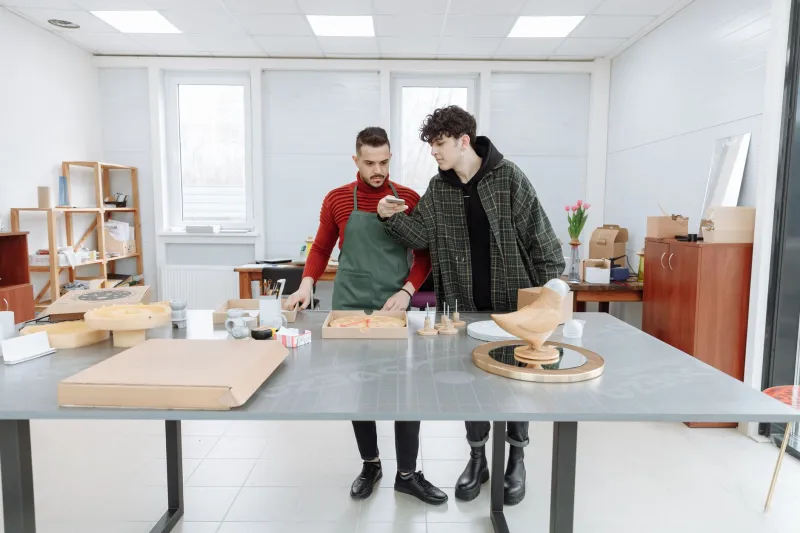
On a Thursday night in a Sheffield pub back room, the table is covered in things that are not finished. A mug with no handle. A half-jointed stool. A lino cut that is still mostly blank. Nobody is apologising for it. That is the point.
Welcome to the work-in-progress meetup: part peer critique, part tea-and-biscuit surgery, part gentle rebellion against the polished showcase. Instead of waiting until a piece is ready for an exhibition, a shop shelf or the grid, makers are bringing the awkward middle stage to a room full of others and asking for help.
Why the half-made thing is having a moment
Makers spend a lot of time alone. Studio days can be long, and the pressure to post only the finished, well-lit object is real. Perfectionism creeps in quietly. You remake the same seam, re-glaze the same bowl, redraw the same joint, and convince yourself that nobody needs to see it until it is right.
Work-in-progress nights flip that. The rule is simple: bring the thing you cannot solve on your own. Not a portfolio. Not a sales pitch. A question. The format is cheap to run, easy to repeat and unusually good at loosening the grip of perfectionism. It is also the sort of low-key, high-support thing Creative Sun was set up to champion: makers meeting, sharing and making things happen without waiting for permission.
Sheffield: feedback at the rough end
The Rough Edges group meets on the second Thursday of the month in a pub back room near Kelham Island. It was started by a ceramicist and a furniture maker who were both tired of working in isolation. Around twenty people turn up on a good night, with a mix of potters, printmakers, jewellers and woodworkers. There is a £3 whip-round for the room and a strict no-pitching rule.
Each maker gets ten minutes. They say what the object is, what they are stuck on and what they have already tried. Then the room asks questions before offering advice. The tone is direct but not brutal. 'That's lovely' is allowed only if you can say why. A potter brought a glaze that had crawled and left with three possible fixes. A woodworker brought a chair with a wobble and left with a name for a local machinist who could help.
The group is not a competition. It is a room full of people who have all made bad decisions with materials and lived to tell the tale.
Bristol: the seam you're scared of
Bedminster Work-in-Progress meets on a Sunday afternoon in a community hall with good light and a slightly temperamental kettle. The group began with sewists and printmakers, but it now pulls in a bookbinder, a basket maker and the occasional knitter. The organiser, a textile designer, uses question cards to keep feedback useful: What are you stuck on? What have you tried? What would help?
One rule has become quietly famous among members: finished work is allowed only if you can show the messy back. The idea is not to ban polish, but to make the hidden labour visible. People bring the seam they are scared of, the print that is off-register, the pattern that does not fit. The room is child-friendly, and there is a corner with toys for makers who are also parents.
It is not therapy, but it does something similar. It normalises the messy middle. Members say the Sunday session has made them less likely to abandon a project at the first wobble.
Rural Norfolk: the long table and the lift share
In rural Norfolk, the meeting happens once a month in a village hall near Aylsham. The table is long, the tea urn is large and the group is deliberately spread across disciplines: woodworkers, printmakers, a basket maker and a ceramicist who drives forty minutes to get there.
Isolation is the real problem here. The group coordinates lift shares and shares tools between meetings. Someone brings a spare set of chisels; someone else lends a book on natural dyes. The format is looser than in the cities: a show-and-tell at the start, then small clusters of conversation, then a whole-room check-in at the end.
What they have in common with the city groups is the honesty. A maker brings something they cannot solve alone. The room listens. The drive home is shorter than the drive out, somehow.
How to start your own in 2026
You do not need funding, branding or a committee. You need a room, a table, a kettle and three people willing to bring something unfinished. Here is a practical starting point for 2026.
- Find a room that does not intimidate. Library meeting rooms are often free or cheap. Pub back rooms can be free on quiet nights if you ask. Community halls usually cost £10–£20 an hour. Check tables, good light, accessible entrances and power sockets.
- Set a simple shape. Two hours is plenty: twenty minutes of tea and settling, three or four fifteen-minute slots, a short break, then an open table for informal chat. Keep time so nobody dominates.
- Invite beyond your discipline. A ceramicist next to a sewist next to a woodworker is not a gimmick. Cross-material advice is often the most useful. Use library noticeboards, local maker WhatsApp groups and Instagram. You do not need a website.
- Make it safe. No selling, no scoring and no unsolicited rewrites. Use a talking object to keep feedback focused. Ask questions first: 'What have you tried?' 'What would help?' 'I notice... I wonder...' Avoid 'you should'.
- Keep it cheap and repeatable. Free or £2–£3 on the door. A paper sign, a kettle and a shared biscuit tin will do more than a logo. Check the venue's public liability cover, especially if you are using community halls.
- Run it for three months before judging it. Consistency beats perfection. The first session might be four people. That is enough to start.
The point is not to finish the object. It is to leave less alone with it. In 2026, that might be the most useful thing a creative community can offer.