Your Library Card Now Comes With a Safety Briefing: Inside the UK's Part-Time Workshops

Photo: Michal Klajban, CC BY-SA 4.0, via Wikimedia Commons
There's a particular sound in a British library at half six in the evening that isn't supposed to be there. Not the stamp, not the trolley, not the low murmur of someone negotiating a renewal. Something with a motor in it.
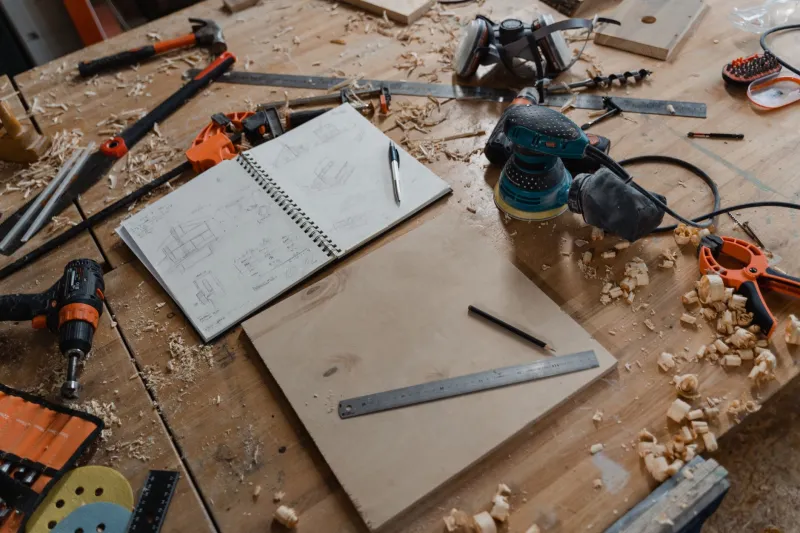
Alongside the book stacks, in rooms that spent decades holding reading groups and council meetings, makers are setting up. Print corners. Repair benches. A small lathe that gets wheeled out of a cupboard and wheeled back in again. Nobody's rebranding the building as a fab lab; the books aren't going anywhere. But the library has quietly become one of the most interesting part-time workshops in the country, and it happened without much fuss at all.
The room that already has everything except the tools
Think about what a library already offers a maker. A building on the high street with a ramp and a lift. Public liability sorted. Opening hours that stretch into the evening. A room you can book. Staff who are used to handling strangers with patience and a complete absence of judgement. Somewhere to leave your coat.
That's most of the hard stuff. What's missing is the equipment and someone who knows how to use it — which is precisely the gap a residency fills.
"We spent years trying to work out how to get making out of the shed at the bottom of the garden," a library development officer in the East Midlands told me. "Then we looked around our own building and realised we'd been sitting on the venue the whole time."
Residencies tend to run in short bursts — a few weeks, sometimes a term, occasionally a full year if a grant lands. A ceramicist takes over a corner on Saturdays. A bike mechanic runs a fix-it table on the first Thursday of the month. A printer teaches letterpress on a table that is, the rest of the week, where the children's craft club happens.
Low cost, high trust
The cost side is the obvious draw. A private studio in a British city can run into the hundreds per month before you've bought a single tool. Even a shared membership scheme assumes you can pay up front and commit to a rota. Libraries ask for nothing except that you turn up and don't damage the returns trolley.
But it's the trust that does the real work. There is no other building in a British town where you can walk in off the street with no appointment, no membership and no explanation, and be treated as though you belong there. That matters enormously to people who would never sign up for a studio — the ones who assume maker spaces aren't for them, or who've been in one and felt the chill of an in-joke they weren't part of.
I've watched a woman in her seventies learn to use a sewing machine on a table next to a teenager mending a jacket. Neither of them had booked. Neither of them would have crossed the threshold of a membership workshop. Both of them were making something by eleven o'clock.
What the library gets back
Libraries aren't doing this out of sentiment. Footfall is footfall, and a repair bench on a Saturday pulls in people who haven't borrowed a book in a decade. Those people see the noticeboard. They see the toddler rhyme time on the way past. Some of them come back for the books.
There's a skills argument too. Library services have spent years absorbing the language of digital inclusion and digital skills; making is the same argument with a different tool in your hand. A council that can say it runs soldering sessions is a council with something to say when the funding conversation comes round.
And residencies bring in people the library wouldn't otherwise reach — retirees with a workshop in the garage and no one to pass it on to, for a start. The best of them are less about the object being made than the transfer of a lifetime's competence to a room of strangers.
The awkward bits
It's not frictionless. Noise is a genuine issue in a building where people are trying to read. Dust is worse. Some residencies have died quietly because a vacuum extractor turned out to be the one thing the budget couldn't stretch to.
Insurance takes sorting. So does the question of who's supervising, and what happens when a member of the public wants a go on something with a blade in it. The answer is usually a very short, very clear demonstration, a signed slip, and a member of staff who stays in the room.
Storage is the perennial complaint. A maker who has to unpack and repack a workshop every session loses an hour of every session to logistics. The libraries that make this work are the ones that found a cupboard and gave it a lock.
And there's the obvious tension: library budgets are not generous, and a residency is not free. Most are funded through small grants, friends groups, or a partner organisation that needed a room. Nobody has yet worked out a model that survives the end of the grant, which is why the sector still feels like a scatter of brilliant one-offs rather than a settled programme.
How to find your local one
Ask at the desk. That's genuinely it — these things are advertised on photocopied A4 more often than on a website. Look for notices near the returns trolley, follow the library service's social accounts, and check whether your council runs a "library of things" alongside it, since the two often grow in the same soil.
If there's nothing, ask anyway. Every residency I've come across started with somebody asking whether they could bring a machine in.
The long loan
A library card has always been a strange kind of membership — free, local, and quietly radical in what it says about who a town's resources belong to. Extending that to skills and tools rather than only to books is a small step with a long shadow.
And if the reading room smells faintly of linseed oil on a Thursday night, that's not a problem. That's the whole point.