Glass Roof, Open Door: The Conservatory Studios Warming Up the UK's Winter Craft Scene
Conservatories have a reputation problem in the UK. Too hot in July, too cold in January, and forever caught between being a room and being a very expensive corridor to the garden. But this winter, a quiet shift is happening behind those sliding doors. Makers are claiming the glass room as a small, heated, deeply domestic studio — and inviting a handful of neighbours in.
The appeal is practical. Garages are freezing, sheds leak, and community studio rents keep climbing. A conservatory has light, a door to the kettle, and a floor that can be swept. It also has a built-in limit: nobody expects a conservatory to become a public workshop. That limit is the point. These are not venues. They are hosting spaces, with all the intimacy and awkwardness that word implies.
Sheffield: clay, condensation and a strict Tuesday
Rosa throws pots in a conservatory off her kitchen in Walkley, Sheffield. The space holds a wheel, two folding tables, a bucket station and a oil-filled radiator that runs from October. She opens it on Tuesday evenings from six until eight, six people maximum, and the sign-up sheet closes on Sunday night.
The rules are simple and slightly ruthless. Shoes off at the kitchen door. Aprons on. No clay down the sink. Everyone helps wipe the floor before they leave. Rosa keeps a lidded bucket for slip and a separate bin for trimmings, and she runs a dehumidifier overnight when the windows start to stream.
What makes it work is the schedule. A fixed weekly window means the conservatory does not become a drop-in centre. People arrive, make, drink tea and go home. Rosa says the two-hour limit protects the room and the host. It also gives the session a shape: a short demo, a stretch of quiet work, then a shared tidy-up. The tea rota is not optional. Neither is the biscuit tin.
Norwich: lino, low sun and a drying line over the sofa
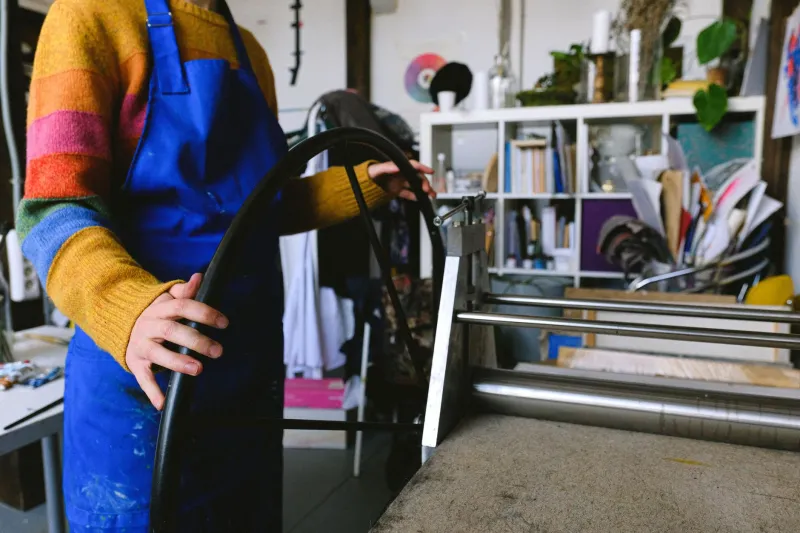
In Norwich, printmaker Dev uses a conservatory in NR3 as a winter lino studio. The press lives on a folding table. Ink stays water-based. The drying line runs above the sofa, which sounds chaotic until you see the pegs: every print is labelled, every sheet is timed, and nothing comes inside wet enough to mark the cushions.
Dev runs Sunday afternoons, four people at a time, and describes the session as a quiet co-working slot rather than a class. People bring their own lino and tools, or borrow a spare set. The conservatory gets good winter light until about half three, so the first hour is for cutting and the second is for printing. After that, the overheads go on and the room becomes a cleaning and chat space.
There are compromises. Solvents are out. A small extractor fan handles the worst of the ink smells, and the door to the garden stays cracked for ten minutes after each session. Dev asks guests to carry their own cutting mats and to keep bags off the floor. The conservatory is not a licensed studio, and it doesn't pretend to be. It is a bright room with a kettle, a roll of lining paper and a host who has thought carefully about what can go wrong.
Cardiff: the Thursday mending table
In Cardiff, a textile group meets in Mari's conservatory in Canton on Thursday mornings. The table is long, the chairs are mismatched, and the ironing board doubles as a pressing station. Six regulars bring mending, patchwork and hand-sewing. One sewing machine runs at a time, plugged into a circuit that has been checked and not overloaded.
The group has a rota for tea and a small kitty for milk and biscuits. Mari keeps a first-aid tin in the kitchen and a fire blanket by the conservatory door. She also keeps a laminated sheet of house rules: no hot irons near the fabric pile, no cutting on the good table without a mat, and no unannounced guests. The last rule matters. A conservatory can absorb a lot of goodwill, but not an endless stream of people who heard about it through a friend.
What the group has built is less a workshop than a soft commons. People arrive with a broken hem and leave with a repaired one, plus a recommendation for a decent zip supplier and an opinion on the best cheap thread. The making is the excuse. The Thursday morning is the thing.
The practical bit: insurance, boundaries and the biscuit economy
Opening a conservatory to other makers is not the same as running a public workshop, but it is not nothing either. Tell your home insurer what you are doing. Check whether your policy covers visitors, tools and public liability. If you are charging, even to cover materials, ask the insurer directly whether that changes your cover. Some hosts join a craft organisation that includes public liability. Others keep sessions free and pass a tin for tea. Neither approach replaces a proper conversation with an insurer.
Then there are the physical limits. Keep numbers small. Ventilate when using inks, glues or sprays. Keep heaters away from fabric and paper. Check extension leads and avoid daisy-chaining them. Have a fire blanket and a first-aid kit. Think about step-free access and where guests will use the loo. A conservatory may be domestic, but a threshold is still a threshold.
Scheduling helps more than any rule. A fixed weekly window, an RSVP list and a waitlist turn an open door into a workable session. So does a clear end time. The tea rota is not a joke: it shares the hosting labour and stops one person from becoming a permanent caterer. A biscuit kitty is a small, elegant solution to a surprisingly large social problem.
Why the glass room works
Conservatories are not going to replace community studios. They are too small, too domestic and too dependent on one person's goodwill. But they fill a gap that purpose-built spaces often miss: the short winter evening, the neighbourhood scale, the feeling that making can happen ten steps from the kitchen.
As the UK's maker scene looks for warmer, closer, more resilient places to gather, the conservatory is doing what it has always done best. It is letting the light in. This winter, it is letting people in too — six at a time, with a brew and a tidy-up rota.