A Pattern's Paper Trail: Inside the UK's Postal Sewing Circles, Where the Margins Do the Teaching
On a wet Tuesday in Leeds, a brown A5 envelope lands on a doormat. Inside: a traced bodice front, two sleeve pieces, a scrap of printed cotton, and a pencil note that reads, 'I took 2cm out of the waist — you might not need to.' This is not a transaction. It is a lesson, folded into thirds and sent second class.
Across the UK, a quiet postal network is doing something the sewing internet rarely does: slowing down. These are the pattern swappers, the trace-and-post circles, the sewists who would rather send a paper pattern through the mail than click 'download'. Their envelopes carry hand-drawn pieces, altered blocks, fabric swatches and enough marginalia to fill a small night class. And the margins, it turns out, are where the real tuition lives.
The envelope as a syllabus
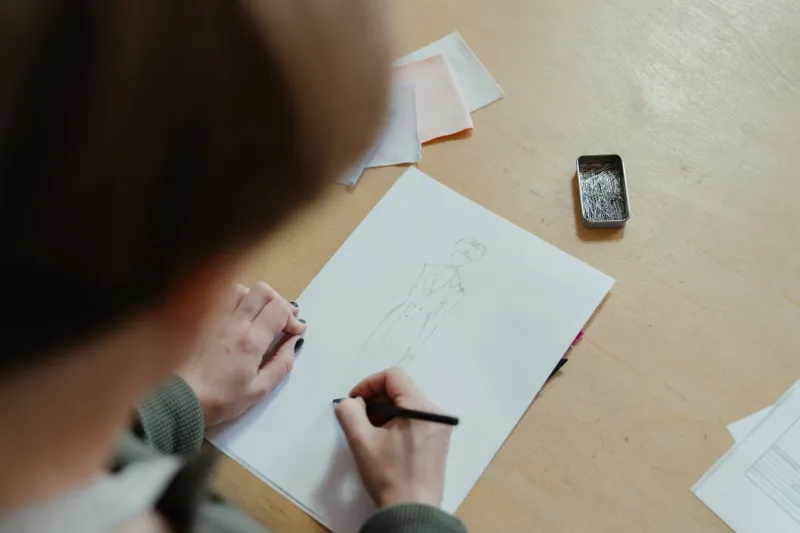
A typical parcel in these circles is not a pristine commercial pattern. It is a working document. Someone has traced a size 14 bodice onto Swedish tracing paper or, more often, greaseproof paper from the kitchen drawer. The pieces have been cut with pinking shears, labelled in biro, and folded around a sheet of A4 that explains what changed and why.
'You get the pattern plus the edits plus the reason for the edits,' says Marek, a furniture maker in Bristol who took up sewing to make canvas tool rolls and now swaps patterns with a group in Glasgow. 'A PDF gives you a line. An envelope gives you a conversation. I know that the person before me shortened the torso by 3cm because they are 5ft 2in. I am not 5ft 2in, but I now know what that alteration looks like on paper. That is free education.'
The contents vary. A traced copy of a favourite skirt block. A hand-drawn facing piece on cereal-packet card. A paper toile that has been unpicked and flattened. Sometimes a small square of fabric, stapled to the corner, so the next person can feel the weight and stretch before they commit to a metre of their own.
What gets scribbled, and why it matters
The annotations are the point. In one envelope circulating among a Newcastle sewing group, a bust dart is ringed in red with the note 'this is the one that fixed the gaping'. In another, a sleeve head carries the words 'ease, don't pleat — I learned the hard way'. There are arrows for grainline, crosses for notches, and small sad faces next to seams that were unpicked three times.
For Nia, a textile artist in Cardiff, the scribbles act as a kind of distributed apprenticeship. 'When you learn to sew on your own, you miss the person looking over your shoulder,' she says. 'The margin notes are that person, preserved. Someone has already made the mistake you are about to make. They have written it down in pencil because they weren't sure either. That is more useful than a perfect tutorial.'
The notes are not always technical. Some envelopes carry measurements, a washing instruction, or a warning about a fabric that frayed 'like mad'. Others include a small drawing of how the pieces should lie on the cloth. It is practical, unglamorous knowledge, passed hand to hand.
Paper versus PDF: a question of scale and company
PDF patterns are convenient. They are also flat. You print them, tape them together, and hope your printer has not stretched the scale by two per cent. Paper patterns that arrive by post have already been through someone else's printer, someone else's table, someone else's body. The scale is not a mystery; it is a record.
There is also the matter of company. A downloaded pattern is a solitary object. A posted pattern has a return address. It carries the expectation that you will add something, fold it back up, and send it on. In a hobby often practised alone at a kitchen table, that expectation is quietly powerful.
How the circles keep turning
Most of these groups begin informally. A comment on an Instagram post, a noticeboard at a local sewing shop, a conversation at a mending cafe. Someone offers to trace a pattern for someone else. Someone else offers to post it back with their own alterations. Soon there is a list of names, a rota, and a shared understanding that the envelope will keep moving.
Some circles are local and meet monthly to swap in person. Others are purely postal, spanning the UK from Belfast to Brighton. They use second-class stamps, recycled envelopes, and a shared spreadsheet to track who has what. The waiting is part of the appeal. A PDF arrives instantly and is often forgotten. An envelope arrives when it arrives, and when it does, you clear an evening.
The etiquette of the hand-me-down
There are rules, though nobody writes them down. Trace carefully. Do not keep the original longer than agreed. Add your notes in pencil, not pen, so the next person can rub them out if they disagree. Credit the person who drafted the piece if you pass it on. And never, ever send a pattern you have not checked for missing pieces.
'It is a bit like a library, but the books come with annotations,' says Marek. 'You borrow, you add, you return. The pattern gets better each time. Or at least more honest.'
Waiting as part of the craft
In a culture of instant files, the postal pattern circle is a small act of resistance. It asks sewists to wait, to read someone else's handwriting, to trust a stranger's alteration. It turns a solitary craft into a correspondence. And it leaves a paper trail — not just of seams and darts, but of people who took the time to explain.
For Creative Sun, it is a reminder that making things is rarely just about the thing. It is about the notes in the margin, the scrap of fabric, the envelope that lands on a wet Tuesday. The pattern is only half the lesson. The rest is in the post.