A Litre of Fixer and a Place to Fail: Inside the UK's Member-Run Darkrooms
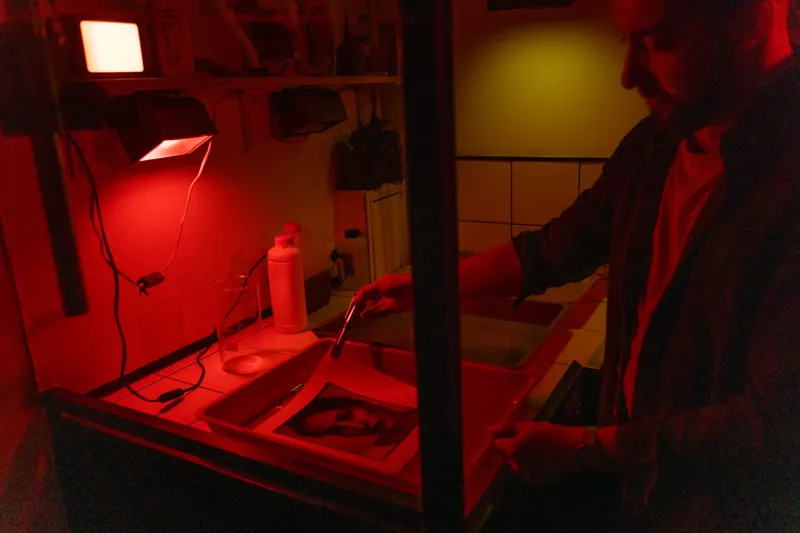
The first thing you notice is the smell. Not unpleasant, exactly — a sharp, vinegary tang of stop bath, the faint eggy whiff of fixer, the papery dust of a room that has seen a thousand test strips. The second thing you notice is the etiquette. You knock. You wait. You listen for the call of “safe” before you even think about touching the handle. In a member-run darkroom, the red light is not a gimmick. It is a social contract with a bulb in it.
Across the UK, these spaces are quietly multiplying. You will find them in railway arches in Leeds, in church basements in Cardiff, in shared studio buildings in Glasgow and in the back rooms of photography co-ops from Bristol to Sheffield. Some are run by volunteers, some by members’ committees, some by a single stubborn person with a key and a spreadsheet. What they share is a simple idea: if enough people chip in for chemistry, paper and enlarger bulbs, everyone gets a place to make photographs slowly, badly, then better.
The economics of a shared tray
Film photography has never been cheap, but the costs are strangely communal. A litre of fixer does not care whether you are a student or a retired engineer. A box of 10x8 paper is a box of 10x8 paper. What changes is how many people can use it before it runs out.
Member-run darkrooms tend to operate like tiny utility companies. There is a monthly fee, or a per-session charge, or a rota of cleaning duties that functions as an alternative currency. There is usually a chemistry log: a clipboard or a shared spreadsheet where someone writes down what was mixed, when, and whether it is still good. The communal fixer becomes a moral object. Use it carelessly and someone will notice. Label your bottles and you are basically a good citizen.
“We worked out early on that the enlargers were the easy bit,” says one volunteer at a darkroom in a railway arch in West Yorkshire. “It’s the consumables that bite. So we buy in bulk, split the bill, and everyone learns to do a test strip before they commit to a full sheet. It makes you a better printer, honestly. You stop wasting paper because you know someone else paid for half of it.”
That practical thrift shapes the culture. People share developing tanks. Someone brings in a box of expired paper and leaves a note. A member who upgrades their easel donates the old one. The darkroom becomes a small, functioning household — one with stricter rules about cleaning up than most flats.
The rota is the real equipment
Walk into a community darkroom and you will see the obvious kit: the enlargers, the timers, the trays, the safelight. But the real infrastructure is the rota. Who opens up? Who inducts the new member? Who checks the fixer? Who remembers to buy more gloves?
In 2026, many of these spaces run introductory sessions rather than formal courses. The model is less “teacher at the front” and more “bench, trays, and a body who has done it before”. A new member learns to load a reel in the dark, mix developer at the right temperature, and resist the urge to open the door when they hear someone in the corridor. The teaching is practical and repetitive, which is exactly what film processing rewards.
Critique nights are the other half of the equation. Members bring contact sheets, work prints, maybe a failed negative they cannot explain. The conversation is slow because the medium is slow. You cannot scroll a contact sheet. You have to lean in, squint, and point. “There’s something in frame four” is a complete sentence in a darkroom. Nobody is chasing likes. They are chasing a better print.
Slow photography, fast friendships
There is a particular kind of friendship that forms over a tray of developer. It is not quite a club and not quite a class. It is closer to a workshop in the old sense: a place where people make things alongside each other and learn by overhearing.
Part of the appeal is the enforced patience. Film has to be developed, washed, dried, printed, washed again. You cannot rush the fixer. You cannot skip the wash. In a culture that keeps promising to make everything instant, a darkroom is a small, red-lit protest. The image appears slowly in the tray, and so does the community around it.
That slowness also makes room for people who would not call themselves photographers. Printers, bookbinders, zine makers and illustrators drift in because they want a photographic element in their work. A shared darkroom in Bristol sits in the same building as a printmaking co-op; in Sheffield, one is accessed through a bike workshop. The cross-pollination is part of the point. You come for the enlarger and stay because someone is making a photobook at the next bench.
What to bring, what to leave at the door
If you are looking for a darkroom in 2026, start local. Photography groups, university print facilities that open to the public, arts charities and studio co-ops are all worth asking. Some spaces advertise inductions; others rely on word of mouth. Expect to pay something, even if it is modest. Expect to be shown the chemistry log. Expect to be told off, gently, if you leave the trays unwashed.
Bring your own film and paper if you can. Bring patience. Leave behind the idea that you need expensive kit to begin. A shared darkroom is not a luxury facility; it is a bench, a light, and a group of people who have agreed to share the cost of making something real.
The red light is on. Knock first.