The Wall That Runs the Workshop: Inside the UK Studios Held Together by a Noticeboard
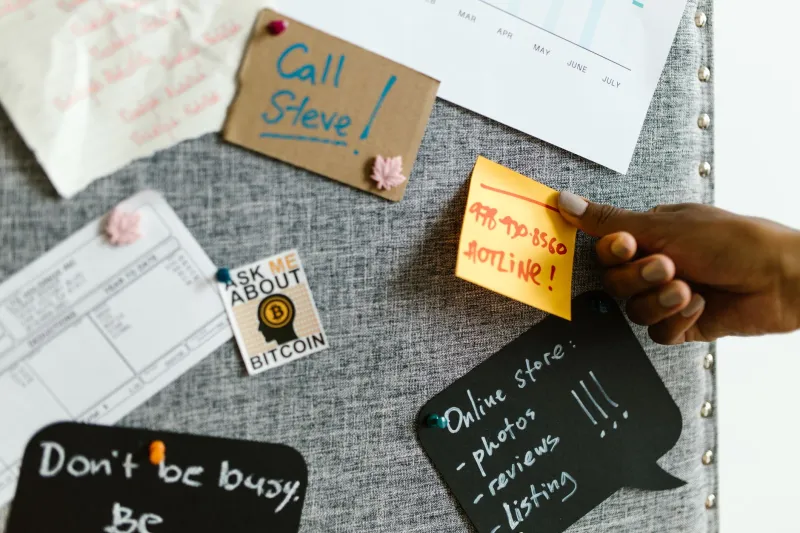
Walk into a shared maker space in Leeds, Bristol or Glasgow and you will usually find the same humble piece of kit near the door: a corkboard, a whiteboard, or a patch of wall that has been quietly promoted to management. It is where a missing chuck key gets reported, where someone offers a spare hour on the kiln, where a visiting artist asks for help lifting a sheet of ply. In 2026, the studio noticeboard is still doing the work that countless group chats were supposed to replace.
That is not nostalgia. It is infrastructure. A board is public, asynchronous and stubbornly visible. It does not ping. It does not bury yesterday’s request under a hundred messages about lunch. It waits by the kettle, in the path of anyone who might be able to help.
The original shared drive
The best studio boards are less like a pinboard and more like a small, analogue operating system. Tool loans are logged with a name, a date and a return-by scribble. Rota shifts are swapped with a crossed-out line and an initial. Micro-commissions appear on index cards: a photographer needs a plinth by Friday, a jewellery maker wants a second pair of hands for a market stall, a ceramics studio is looking for someone to run a Saturday glaze session.
Then there is the lost property, which on a good board has its own corner: one earring, a pair of safety glasses, a notebook with no name but very distinctive coffee rings. And then the quiet grievances — the note asking, politely, that whoever used the last of the shellac writes it on the shopping list; the reminder that the extraction fan needs to be switched on before the resin comes out. These are not petty. They are the small maintenance conversations that keep a shared space from sliding into resentment.
A board works because it is slow enough to be fair. Everyone sees the same thing at the same time. There is no administrator, no muted thread, no read receipt. A pin is a small public commitment.
What the group chat cannot hold
Group chats are excellent for urgency. They are terrible for memory. A message asking for the mitre saw at 9am is gone by lunchtime, buried under photos of someone’s new glaze test and a debate about the best chip shop near the studio. A noticeboard does not scroll. It holds the request in place until someone acts on it or takes it down.
That persistence matters most for the people who are not in the chat at all. Visiting artists, part-time members, older makers who prefer not to live on their phones, new joiners who have not yet been added to the right WhatsApp group — all of them can read a wall. A board is one of the few pieces of studio communication that does not assume a smartphone, a data plan or a tolerance for notification noise.
There is also the tone question. A group chat can turn a small irritation into a pile-on in minutes. A noticeboard slows the conversation down. A handwritten note about cleaning the glaze buckets reads differently from a message fired off at 11pm. It is public, but it is also quiet. That combination is surprisingly good for community maintenance.
Cork as community infrastructure
In 2026, the studios that do this well are treating the board as a designed object rather than an afterthought. The best examples tend to share a few habits. They divide the wall into zones — borrow, offer, notice, lost, maintenance — so nobody has to hunt. They keep a small shelf underneath for the things that need to travel with the note: a sample tile, a broken hinge, a spare key. They use transparent sleeves so that rain, clay dust and repeated handling do not destroy the information.
Some boards now carry QR codes, but usually as a support act rather than a replacement. Scan the code and you get the tool-booking form or the rota spreadsheet; the board still tells you that the thing exists. Others use colour-coded tags for urgency, though the most effective studios resist over-engineering. A board with too many systems is just a filing cabinet that nobody opens.
Accessibility matters too. A well-designed board has a lower section for wheelchair users and shorter members, large-print notices for key information, and a clear rule that anything faded or out of date gets removed at the monthly tidy. The board is only as good as its housekeeping. A wall of yellowing flyers from 2023 is not a community resource; it is wallpaper.
The limits of the wall
None of this is to pretend that noticeboards are perfect. They can become cliquey. Handwriting can exclude. A board in a studio with members who speak different first languages needs more than a biro and good intentions. And there is a real risk that the board becomes a place where the same three people leave notes for each other while everyone else walks past.
The answer is not to abandon the wall for a group chat. It is to hybridise carefully. Several UK studios now post a weekly photograph of the board into their digital channels, so remote members can see what is happening without moving the whole conversation online. The board remains the source; the photo is a service. That is a useful distinction. Digital tools should carry the board outward, not replace it.
What gets lost when studios move everything into group chats is not just information. It is the shared glance. The moment you walk in, put down your bag and see that someone needs a hand on Thursday. The low-stakes, high-visibility contact that turns a rented bench into a community.
In 2026, the group chat may be the loudest room in the studio. The noticeboard is the one that remembers. And in the best UK maker spaces, that wall by the kettle is still the front page — a small, pinned, stubbornly analogue reminder that a studio is not just a room full of tools. It is a group of people who have agreed to keep an eye on the same piece of cork.